മലയാളം
A language that reads the same backwards
Spell it in English, M-A-L-A-Y-A-L-A-M, and it is a palindrome. Beyond the party trick, Malayalam is one of India's officially recognised classical languages, with a script of rounded, flowing letters and a literature over a thousand years old.
The basics
Mala + alam: the land of mountains
The name is usually explained as mala (mountain) and alam (place or region): the language of the hill country. Malayalam belongs to the Dravidian family of South India, alongside Tamil, Kannada and Telugu, and is unrelated to Hindi or the languages of Europe.
It grew out of an early form of Tamil and absorbed a great deal of Sanskrit vocabulary, giving it a rich, layered sound. Centuries of trade added words from Arabic, Portuguese, Dutch and English. The Malayalam word for "window", ജനൽ (janal), comes from Portuguese janela.
In 2013 the Government of India declared Malayalam a Classical Language, recognising its antiquity and independent literary tradition.
The script
Letters shaped by palm leaves
Malayalam was traditionally written with a stylus on dried palm leaves. Straight lines would split the leaf along its grain, so the letters evolved into curves and circles. The script descends from the ancient Grantha and Vatteluttu alphabets.
The letter ഴ (zha), a sound between "r" and "l", is famously hard for learners. It appears in Kozhikode and mazha, the word for rain.
Try it
Your first words in Malayalam
Use one of these at our next event and watch someone's face light up. Tap a card to hear it (your device needs a Malayalam or Indian English voice).
Literature
A thousand years of stories
Kerala's love of reading is legendary: almost every village has a public library, and Malayalam newspapers are among the most widely read in India.
Early classics
Ramacharitam and the Manipravalam poetry, a blend of Malayalam and Sanskrit, mark the beginnings of Malayalam literature.
Thunchaththu Ezhuthachan
Honoured as the father of modern Malayalam, his retellings of the Ramayana and Mahabharata are still read aloud in Kerala homes every monsoon month of Karkidakam.
Kunchan Nambiar
A satirist who invented Ottan Thullal, a fast, funny solo performance that poked fun at the powerful in everyday language.
The modern masters
Vaikom Muhammad Basheer's warm, wry short stories; Thakazhi Sivasankara Pillai's Chemmeen, a fishing-village love story; and M. T. Vasudevan Nair's novels and screenplays made Malayalam literature famous across India and in translation.
Six Jnanpith Awards
G. Sankara Kurup received the very first Jnanpith Award in 1965. He was followed by S. K. Pottekkatt, Thakazhi, M. T. Vasudevan Nair, O. N. V. Kurup and Akkitham Achuthan Namboothiri.
Cinema
Small industry, big reputation
Malayalam cinema, sometimes called Mollywood, is known across India for realism, sharp writing and natural acting. Directors such as Adoor Gopalakrishnan and Shaji N. Karun have won prizes at international festivals including Cannes and Venice.
A new generation of filmmakers has taken Malayalam films to global streaming audiences. Thrillers like Drishyam were remade in several languages, and 2018, about the Kerala floods, was India's official entry for the Academy Awards.
If you want one film to start with, ask any Malayalee at our events. Be prepared for a long list.
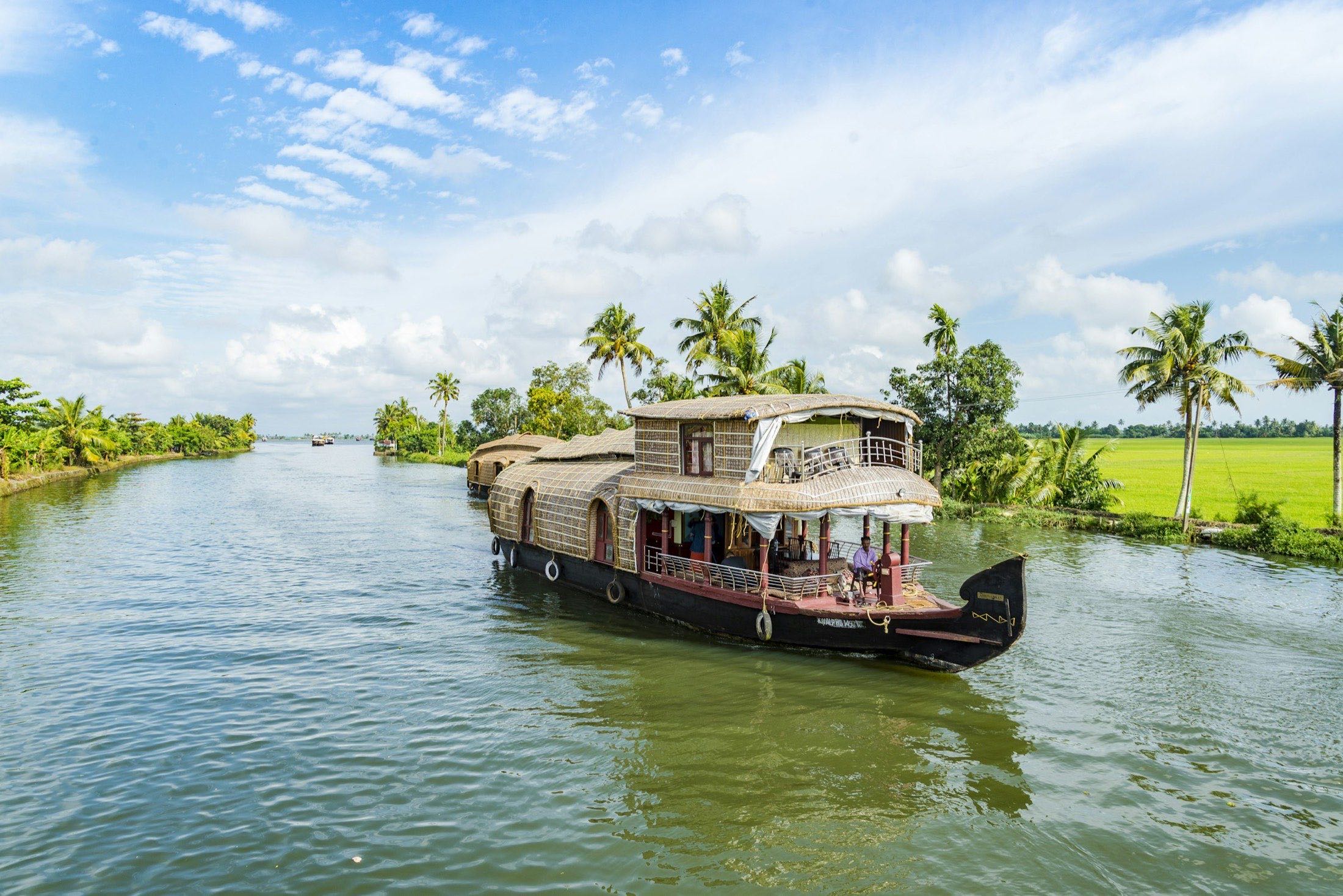 The backwaters, a favourite film location
For families
Raising bilingual kids in Sarnia
We help children growing up in Canada read, speak and sing in Malayalam, so the language lives on in the next generation.
Ask about classes